Militarizing Water: When a Drop Sharpens into a Blade, and Thirst Becomes Policy
Water was never the innocent entity humanity insisted on dressing in transparency, purity, and calm. These were merely aesthetic touches plastered onto truths that do not tolerate decoration. Water as anyone who has known drought or witnessed a quarrel over a well understands is not a benevolent “gift.” At its core, it has always been a tool of power, utilized ever since humans first divided the surface of the earth.
It remained, however, like a concealed weapon: unsheathed only when necessity tightened its grip. And once necessity tightened, water stepped into the open the way a sword leaves its scabbard: unsettling hearts, and unsettling nations.
If the previous century was the century of oil, the one before us is marching, steadily and unapologetically, toward becoming the century of water. This is not because the world has suddenly rediscovered the virtues of rain, but because water has retreated from the places where it once dwelled, withdrawing from maps once regarded as immutable. Rivers are no longer fixed truths, nor are lakes dependable vaults. Whoever doubts this shift need only consult the United Nations: two billion people are drifting toward the mouth of thirst, and twenty-five nations will exhaust their water budgets before the current year even ends.
These are not fear tactics; they are honest descriptions. What used to be called “statistics” now carries a different name: “warnings.”
“Water scarcity is not a stroke of bad luck… It is a collapsing system.”
It is the result of unrestrained population growth, agricultural expansion demanding more than existence can bear, industries that swallow water as if swallowing air, and a climate that increasingly mimics human temperament volatile and unpredictable. Gather these forces, and water emerges as the rarest currency and the most sensitive commodity. It is a resource governed by two obstinate rules: whoever controls the source controls the mouth of the river; and whoever controls the gate controls the fate of those behind it.
The Architecture of Control
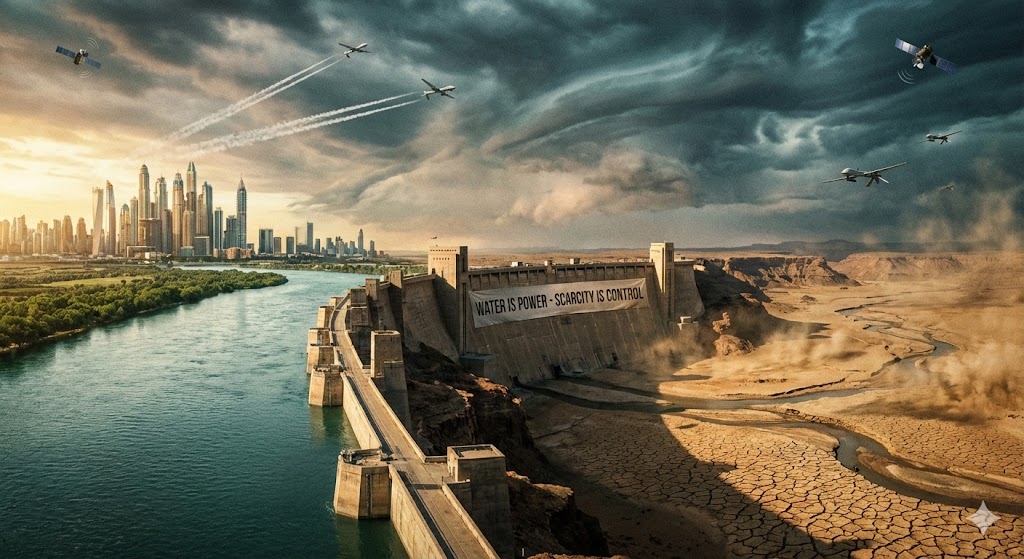
We now watch dams once categorized simply as development projects mutate into political fortresses, nodes of command, and centers of influence no less strategic than air bases. A dam today is not merely a wall holding water; it is an instrument that regulates life or halts it.
The Grand Ethiopian Renaissance Dam is not an internal Ethiopian affair—it is a rewriting of the region’s balance of power. Turkey’s dams on the Tigris and Euphrates are not mere irrigation projects, they are pieces of geopolitical architecture that flow with the water and lock decisions behind concrete.
China’s dams on the Mekong are not just turbines—they are leashes tightened around the necks of six downstream nations. And Israel, a seasoned thief of the resource, has elevated water to a doctrine of national security. For them, there is little difference between a reservoir and a trench—both are defensive lines.
These practices cannot be dismissed as hyperbole. In the eyes of their architects, they are political necessities. The state that holds the source can release water or withhold it, drown fields or starve them, revive cities or extinguish their seasons. Water does not kill with sound; it kills with consequence, destroying agriculture, dismantling economies, unsettling societies, and pushing populations into displacement long before armies even consider confrontation.
This is water militarization in its simplest definition: wars without armies, battles without bullets, and defeats manufactured in silence.
The Sky as a Battlefield
Then comes climate change to deepen the severity. The climate has become a willful actor, rearranging entire geographies. The Rhine thinned until ships halted. The Yangtze exposed a riverbed unseen for centuries. The Colorado shriveled until major cities along its basin began counting drops. Mention Africa, and Lake Chad’s tragedy rises more than ninety percent of it has vanished, leaving behind a cracked earth where migration and extremism multiply like weeds after a wet season.
But the most dangerous shift is not in the rivers—it is in the sky. The heavens no longer belong solely to the unseen. Humanity has entered them as one enters an unclaimed land. Climate engineering once the stuff of speculative fiction has become a door to power.
China seeds clouds to summon rain where it desires. The UAE manages its sky as one manages a city’s infrastructure. Other states experiment silently. The issue is stark: what unfolds above us belongs to no international law, no oversight, and no court. If a nation alters its clouds, redirects its rain, or deprives its neighbors of theirs, how does the aggrieved party protest? And with what evidence?
“The sky becomes an extension of the battlefield, and the air shifts from a blessing to a political dossier.”
Parallel to this, water defenses now supersede oil defenses. Satellites monitor rivers in real time. Sensors track groundwater the way armies track enemy movements. Drones guard dams as if they were nuclear sites. Major powers compile global river data with a precision that would embarrass old maps. This is not a scientific luxury—it is the architecture of a new order built on one principle: whoever knows the water first moves first, and whoever moves first holds leverage.
The Blade of the New Order
With all this, the meaning of thirst and relief changes. Access to water becomes a political privilege, unequal by design. Thirst becomes a slow weapon killing from afar, killing fields before it kills people, killing cities before armies. When thirst meets climatic chaos and tense geography, the scene matures for wars that will never be declared, and collapses that require no cannon.
The world is heading toward a system where power is measured by the rivers a state controls at their sources, the dams it commands at their gates, and the satellites it deploys in its watchtowers. This is not a distant future. It is a present already taking shape etched by states that have declared water not a resource, but a blade.
And so we arrive at a world where sovereignty shifts, power redefines itself, and geography is rewritten in another language: the language of water. It is a world where thirst becomes punishment, quenching becomes a decree, and the drop—with all its ancient simplicity—becomes a bullet fired, a poison spilled, or a suspended promise of life held at the fingertips of whoever understands the game better than the rest.