The Grand Game: A Clash of Strategic Worlds
An exploration of the strategic psychologies shaping modern geopolitics.
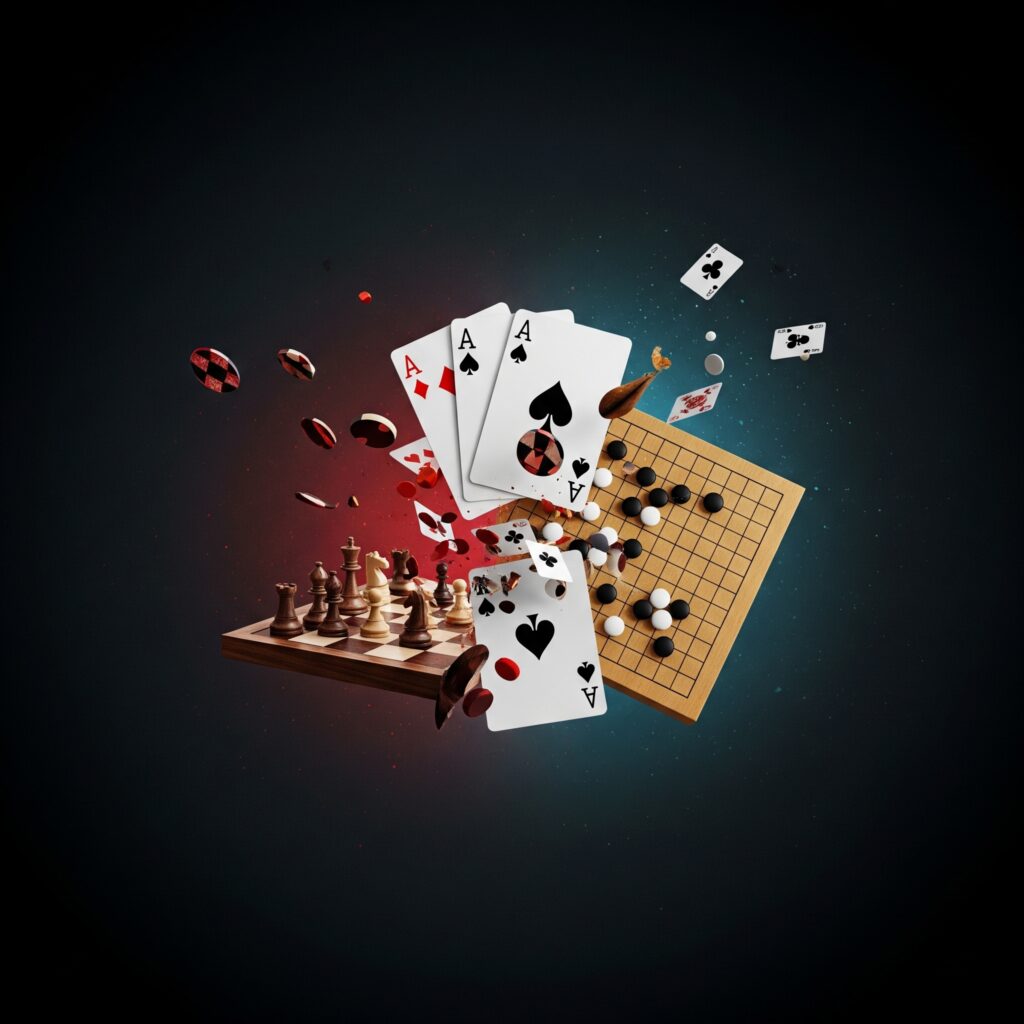
One watches a standoff at the United Nations or a fraught trade negotiation and is struck by the dissonance. The great powers speak, but they do not seem to hear. A threat from one capital is received as a curious maneuver in another; a gesture of conciliation is interpreted as a trap. Why do they so often misread intentions? The answer, perhaps, lies not in the classified cables or the public policy statements, but in the deep, unwritten rules of their native strategic games. These are the psychological frameworks that shape how nations perceive risk, define victory, and wage conflict. The United States plays poker—a game of incomplete information, risk management, and the power of a well-told story. Russia and Iran gravitate toward chess—the game of clear squares and cold calculations. China plays Go—a game of building territory through quiet encirclement, where victory is measured by the accumulation of small margins.
This is not merely a metaphor; it is the operating system running in the background of global affairs. To understand the friction of the modern era is to understand how these three logics collide. This article will explore the mind of each player—the poker player, the chess master, and the Go strategist. We will analyze how their distinct worldviews clash on the world stage and conclude with what this means for the future of global strategy, a future that will belong to whoever can learn to read the whole table.
The Felt Table: America’s Game of Risk and Narrative
Poker is a game of nerve and narrative. It is played with partial information, where the strength of one’s hand is secondary to the strength of one’s story. Victory often goes not to the player with the best cards, but to the one who can best represent a story of strength, forcing others to fold. This is the world the United States has mastered. American power is built not only on the tangible assets of its economy and military—its massive “bankroll”—but on its capacity to leverage that stack through psychological pressure and a mastery of the bluff.
US foreign policy is a clinic in poker strategy, a series of high-stakes moves designed to put opponents on the defensive. Consider the “all-in” diplomacy of “shock and awe” or the issuance of sweeping sanctions—these are aggressive bets meant to overwhelm an opponent’s decision-making process. The declaration of a “red line” is a classic poker move, a dare that forces others to wager on American intentions. The power of the line is not in its enforcement, but in the opponent’s belief that it will be enforced. The narrative is as important as the cards you hold.
This is where America’s dominance in media and public perception becomes a strategic asset. Winning the news cycle is like controlling the table talk, shaping the story to project an image of confidence and inevitability, even when the hand is weak. The nation’s economic leverage, particularly the role of the US dollar, functions as the house’s chips. This massive advantage allows for bigger bets, absorbs losses, and gives the American player the stamina to outlast others. The Cuban Missile Crisis remains the archetypal example: a high-stakes game of nuclear poker where the Kennedy administration stared down its opponent, betting that the other side would fold first. It was a bluff on a global scale, and it worked. But the poker player’s strength is also his weakness. His capital is symbolic, his power vested in credibility. A bluff, once called, shatters that image, and the chips alone are rarely enough to win the next hand.
The 64 Squares: Russia’s Game of Calculated Control
Where the poker player thrives on ambiguity, the chess player operates in a world of perfect information. All the pieces are on the board, visible to both sides. There is no bluffing in chess, only calculation. Victory comes from superior position, the control of key squares, and the patient application of pressure until the opponent’s structure collapses. This is the strategic mind of Russia and, in many ways, Iran. For these powers, the world is a board of 64 squares, and every move is a transaction.
Their foreign policy is driven by a cold, spatial logic. Russia’s fixation on its “near abroad”—the buffer zones of Ukraine and Eastern Europe—is the classic chess player’s drive to control the center of the board, from which all lines of attack and defense emanate. Every piece has a defined value, and moves follow strict rules. A piece may be sacrificed to open a file; an alliance may be traded to secure a more dominant position. Russia’s intervention in Syria was not an impulsive gamble but a calculated sacrifice, expending resources to save a critical piece (the Assad regime) and secure a strategic square on the Mediterranean.
In this world, power is not a narrative; it is a tangible reality. It is the number of tanks on a border, the control of a natural gas pipeline, the position of a fleet. Unlike poker’s ambiguity, chess is about tangible threats. A rook on the seventh rank is a clear and present danger, just as the placement of military assets is an unambiguous signal. The annexation of Crimea was the seizure of a key square, a move to permanently alter the board’s geography. Iran’s methodical use of proxies is the development of pawns into powerful pieces, each positioned to threaten its opponent’s king. This approach gives the chess player a formidable defensive strength and a deep understanding of leverage. Yet, he can be blinded by his own rigid logic, assuming his opponent values the same squares. He can win a battle for position only to discover that the rules of the game have changed, leaving him in control of a beautifully arranged but meaningless corner of the board.
The Empty Board: China’s Game of Patient Encirclement
If chess is a battle, Go is a war of settlement. The board begins empty, and players do not move armies; they place single stones, each one a quiet claim to territory. The aim is not to capture the opponent’s pieces but to subtly surround them, to build influence until their positions are rendered inert. Victory is not marked by a climactic checkmate but by the slow, almost imperceptible accumulation of marginal advantages. At the end of the game, you simply count the territory. This is the strategic soul of China.
Chinese statecraft is the art of Go played out on a global map. The Belt and Road Initiative is the ultimate Go strategy—the placing of stones (ports, railways, fiber-optic cables) across the board. Each stone appears insignificant on its own, but over decades, a vast network of influence emerges, encircling competitors and creating dependencies without a single shot fired. You besiege without provoking and win without fanfare. The “cabbage strategy” in the South China Sea is a perfect illustration: slowly adding layers of ships and structures, quietly building territory until it becomes a fait accompli. There is no single, dramatic move that invites a massive response. It advances like a shadow.
This long view is China’s greatest strategic asset. Unburdened by four-year election cycles or the demand for immediate, telegenic victories, it can pursue objectives that unfold over generations. The Go player is content to lose the media moment, knowing that the quiet has been tallying points all along. The vulnerability of this approach is its pace. A Go strategy can be too subtle, too slow. It risks losing critical ground to a swift, decisive move from a chess or poker player before its encirclement is complete, finding its carefully placed stones suddenly cut off from the whole.
The Grand Mismatch: When Worlds Collide
When these players meet, misunderstandings multiply. The one who sees the world as a chessboard treats every move as a direct threat. The one who sees a vast Go board perceives encirclement where others see none. And the one accustomed to the green felt overestimates the power of a bluff against opponents who don’t even speak the same register.
Scenario 1: The Poker Player Meets the Chess Player.
The United States, holding a mixed hand, issues a bold threat of sanctions against Russia—a classic bluff to force a change in behavior. The American player expects his opponent to weigh the narrative and the potential economic pain, and fold. But the Russian chess player ignores the story. He coolly assesses the tangible balance of power, calculates that he can absorb the economic hit, and makes a quiet, positional counter-move—perhaps by deepening an alliance elsewhere. The American is left stunned, his bluff called by an opponent who was playing an entirely different game of material calculation.
Scenario 2: The Chess Player Meets the Go Player.
A Western power, playing chess, "wins" a direct confrontation. It forces a political concession from China in a small African nation, securing a key diplomatic victory. The chess player believes he has captured an important piece. But the Chinese Go player never cared about that single piece. While the chess player was focused on the battle, China spent the last decade quietly placing stones all around it—funding infrastructure, signing trade deals, and building cultural centers. A decade later, the Western power’s "captured" piece is strategically isolated, its victory rendered hollow by a wider encirclement it never saw coming.
Scenario 3: The Go Player Meets the Poker Player.
The United States orchestrates a massive media victory, winning the news cycle and isolating China diplomatically for a week. It celebrates winning the pot. China appears to lose the moment. It offers no grand counter-narrative and accepts the short-term loss. Meanwhile, it continues its silent work of accumulating territory—patents for new technology, control of critical supply chains, and ownership of digital infrastructure. The poker player celebrates his winnings, not realizing the Go player is slowly buying the entire casino.
Conclusion: Learning to See the Whole Board
The great powers are not just failing to communicate; they are playing different games with different victory conditions. The greatest strategic error, then, is universalism—the quiet assumption that your opponent sees the world, values objectives, and understands power in the same way you do. The chess player's rigid logic fails in a poker game of shifting narratives, and the poker player's bluff is meaningless on a Go board where territory is the only measure of success.
True geopolitical wisdom lies not in mastering one game, but in becoming multilingual—in knowing when to count territory like a Go player, when to calculate position like a chess player, and when to manage risk like a poker player. The future will be a complex hybrid of all three. Durable victory is a chain of small gains paced well; sudden defeat is often the product of a story crafted to perfection—then believed a bit too much. The power that can read the whole table, not just its own hand, will be the one to shape the century.
What's Your Strategic Style?
Click below to reveal your inner strategist.
Saleh Alda
The Strategy Man
Saleh is a strategic consultant who partners with leaders to transform ambitious ideas into market-leading realities. His work sits at the intersection of innovation, sustainability, and strategy, providing the clarity needed to build a resilient and impactful business.